
Europe occupies a contradictory position in the global climate landscape: it is both a historic driver of greenhouse gas emissions and home to some of the world’s most progressive climate policies. Despite its wealth and capacity to fund the transition, Europe’s efforts still fall short of its fair share of climate action.
The European Union’s ambitions under the Green Deal, the Fit for 55 package, and the Clean Industrial Deal, are being undermined by a growing backtracking and deregulation on climate policies, often under the banner of competitiveness and industrial strategy. This trend accelerated in 2025–2026, with the Omnibus I Directive (February 2026) significantly narrowing the Corporate Sustainability Due Diligence Directive (CSDDD) by approximately 70%, removing the obligation for large companies to put a Paris-aligned climate transition plan into effect, and eliminating the EU-wide harmonized civil liability regime. With further “simplification” measures underway, Europe remains on track for 2–3°C warming – well above the Paris Agreement’s 1.5°C goal.
CLIMATE IMPACT – HEALTH
Analysis of daily mortality data from 654 regions in 32 European countries identified 62,775 heat-related deaths in 2024 alone. The 2026 Lancet Countdown Europe reports that 99.6% of monitored European regions have seen rising heat-attributable deaths over the past decade, and extreme heat warnings have surged 318% (from 1 daily extreme warning per year in 1991–2000 to 4.3 in 2015–2024).
Structural inequalities are rising across Europe, with climate impacts hitting marginalized groups hardest. Poorly designed policies for example, regressive energy taxes or green subsidies that benefit wealthier households and corporations can deepen these gaps, while better-off populations continue to drive higher emissions.
CLIMATE IMPACT – ECONOMIC
European Environment Agency data shows climate-related extremes have caused around €650 billion in damages since 1980, with annual losses exceeding €50 billion in 2020–2023. Without further action, climate impacts could reduce EU GDP by approximately 7% by end-of-century, with a cumulative additional GDP reduction of €2.4 trillion between 2031 and 2050 if warming permanently exceeds 1.5°C.
At the same time civic space in Europe is shrinking, with increasing repression and criminalization of climate activism. As political debate grows more polarized-driven by industry influence, populism, and economic pressures- and with tensions hardening with record EU defence spending crowding out development and climate budgets, the urgency for transformative climate action is weakening.
Yet Europe offers strong opportunities for systemic change, with active movements linking climate action to social justice and growing cross-border collaboration. Oxfam-supported campaigns and the CAN Europe Mobilization Platform are building cross-border collaborations and fostering inclusive narratives through digital and local organizing. Participatory models are expanding, and civil society is pushing for fair climate finance and accountability. While the EU’s binding 2040 climate target (90% net GHG reduction below 1990 levels) was adopted in March 2026, it came with significant contingencies. Advocacy around the post-2030 implementation package (ETS revision in July 2026; revisions to LULUCF and the Effort-Sharing Regulation expected Q4 2026) and the 2026 Climate Adaptation Plan will be critical to embed equity and justice.
Linking local action in Europe to global climate justice is essential. The EU and its Member States shape global negotiations, finance, and regulation, making local struggles part of a wider movement. Strengthening these links ensures local perspectives, whether led by youth, migrants, workers, or grassroots coalitions, inform international forums like the UNFCCC and COPs, while collaboration with global partners drives fair climate finance and accountability. At COP30 in Belém in November 2025, Parties agreed to at least triple adaptation finance by 2035 and operationalised the Fund for Responding to Loss and Damage, while taking note of the Baku-to-Belém Roadmap to mobilise $1.3 trillion per year by 2035 within the New Collective Quantified Goal framework thus holding the EU responsible both at home and globally.
Climate justice movements in Europe face a paradox: strong policies and active civic traditions alongside growing repression. Activists—especially youth-led and intersectional groups—encounter increasing legal, financial, and political pressures, as polarization and declining trust in institutions reshape the landscape.
CIVIC SPACE – CLIMATE ACTIVISM
Dutch police arrested more than 700 Extinction Rebellion activists during a single climate action on 11 January 2025. In July 2024, five UK Just Stop Oil activists received four- to five-year prison sentences for participating in an online planning call for a peaceful protest – the harshest UK sentencing for non-violent civil disobedience in modern history. In Germany, Last Generation members were charged under §129 (forming a criminal organisation), the first application of the law to a non-violent protest movement. The European Civil Forum has documented over 450 cases of repression against civil society actors in Europe (2019-2021).
Amid these challenges, movements are renewing but also grappling with burnout, as they face limited resources, and weak policy access. Act for Climate Justice responds by strengthening infrastructure, leadership, and alliances– with a special focus on youth-led, feminist, and intersectional organizing especially in restricted contexts–while supporting wellbeing, safety, and long-term resilience. It also amplifies marginalized voices such as racialized, working-class, queer, and trans communities and boosts policy influence, at local, national, and EU levels, while defending civic freedoms and pushing back against disinformation. By promoting flexible, long-term funding and encouraging donor shifts toward trust-based practices, we seek to build a resilient, inclusive, and effective climate justice movement capable of advancing systemic change rooted in justice, equity, and care.
Europe’s climate finance role is contradictory: despite promoting global ambition, it falls short on funding, especially for adaptation and loss & damage, while domestic resources often miss those most affected and favour private actors.
CARBON INEQUALITY – WITHIN EUROPE
Between 1990 and 2022, EU emissions fell by approximately 21%. The bottom 50% reduced their share by 27% and the middle 40% by 23%, while the richest 0.1% increased their emissions by 14%. The cumulative emissions of the EU’s wealthiest 1% since 1990 have already caused an estimated $179 billion drop in global economic output, falling disproportionately on low- and lower-middle-income countries.
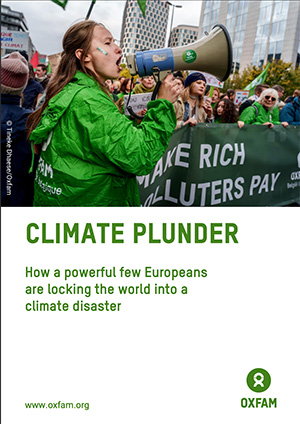
Oxfam and allies promote financial justice by advancing the “polluters pay” principle, debt-free finance, and fair economic alternatives, while pushing for transparency in EU-private sector partnerships. Efforts focus on improving climate finance access, strengthening equity in mechanisms like the Green Climate Fund, and mobilizing public finance through taxation and subsidy reform. Oxfam and CAN are engaging with the EU to increase both the quantity and quality of its international climate finance to become the genuine international climate leader it claims to be.
Advocacy has shifted to defending EU due diligence laws after the 2026 Omnibus I rollback, which sharply narrowed the scope of CSDDD and CSRD and removed mandatory climate transition planning, with attention now on national transposition, simplified standards, and rebuilding civil liability frameworks at Member State level.
EU AS CLIMATE FINANCE PROVIDER
The EU, its Member States and the EIB collectively contributed €31.7 billion in public climate finance in 2024 and mobilised an additional €11.0 billion of private finance. The EU was the largest contributor to the Fund for Responding to Loss and Damage, accounting for ~68% of 2024 commitments. However, independent analysis (CGD, 2024) finds only ~23% of the EU portfolio goes to adaptation when the full envelope is examined, and the Climate Adaptation Finance Index 2024 shows 90% of recipient countries received less than their risk-adjusted fair share.
Adaptation plans exist at EU and national levels but often lag in implementation and exclude underrepresented groups. Cities play a key role, and we support efforts focused on participatory planning, community-led solutions, and direct funding for grassroots actors—ensuring the needs of vulnerable groups are embedded in climate strategies. These efforts must be systematically included in climate plans and strategies of European countries and the EU.
ADAPTATION – DOMESTIC JUSTICE GAP
Eurostat reports that 9.2% of the EU population (around 41 million people) were unable to keep their homes adequately warm in 2024, down from 10.6% in 2023 but well above the 6.9% of 2021. Two-thirds of those affected live in the EU’s four largest economies (Germany, France, Italy, Spain). Rates range from 2.7% in Finland to 19% in Bulgaria and Greece, where Southern and Eastern European countries face structurally higher exposure to energy poverty.
The forthcoming European Climate Adaptation Plan offers a timely opportunity, with adoption expected in late 2026. It will guide Member States on preparedness and risk assessment across key sectors while promoting nature-based solutions. Coupled with the first European Climate Risk Assessment (2024) and the second EUCRA expected later, it provides a key entry point to embed justice and inclusion in future policies.
Europe’s energy transition risks deepening inequality if left to market forces, as benefits favour wealthy households and corporations while others face rising costs and insecurity. A feminist, people-powered, just transition requires regulating corporations, ending fossil subsidies, and ensuring accessible, rights-based green jobs, with strong involvement in national plans and EU energy policies from youth, unions, and social movements.
JUST TRANSITION – FOSSIL SUBSIDIES
EU fossil fuel subsidies were stable around €57-62 billion through 2015-2021 before more than doubling in 2022 (€123 billion). They fell back to €111 billion in 2023 but the European Environment Agency assesses the EU is “likely not on track to make notable progress by 2030, as most Member States lack concrete plans.” More than 60% of 2023 fossil fuel subsidies were concentrated in Germany (€41bn), Poland (€16bn) and France (€15bn).
Advocates push for EU and national frameworks that protect workers and communities, while monitoring green strategies like hydrogen and bioenergy to avoid new extractivism and corporate monopolies under the guise of green innovation. Advocates also promote reducing consumption – especially among the wealthy – to support a fairer transition. Ensuring responsible sourcing of critical raw materials is also key. The demand for critical materials is only expected to grow in the current geopolitical context and rising militarization efforts, making it even more urgent to embed justice, accountability, and sustainability in raw material sourcing.